
Blister on the Nipple and Blocked Milk Duct
This article is about the blister on the nipple, which may appear as a clear blister or as a white or yellow spot, also called a “milk blister,”or "milk bleb" and which sometimes appears at the same time as a blocked milk duct (a hard area on the breast that does not disappear after feeding, with or without signs of inflammation on the breast).

White Spot , Milk bleb or Blister on the Nipple: What Causes It?

A small blister (clear fluid or white or yellow bubble) on the tip of the nipple may appear during breastfeeding. It generally happens if
there are tensions on the breast tissue and inadequate drainage of the milk ducts. For example:
if the baby has a suboptimal latch and suck (e.g., if the toddler is doing gymnastics and contorting while feeding)
in case of trauma related to pumping
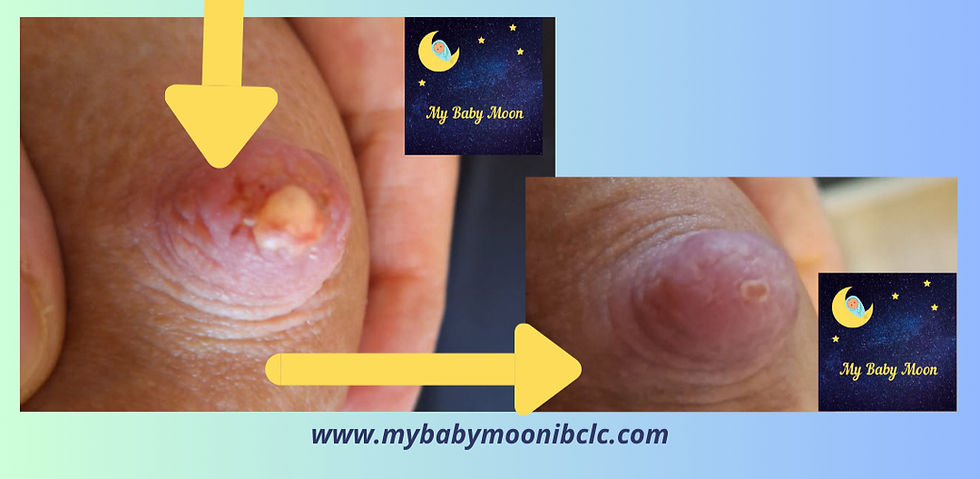
Sometimes in cases of high milk production as well.
If you have a blister on the nipple, pain: you can contact me (it’s my specialty! ;-))
Blister on the nipple and blocked duct
Inflammatory tissue, milk, or a small layer of skin covers the opening of the milk duct, and a small white or yellow spot appears. This may be painless, or sometimes painful to the touch.
There may be a hard area in the breast under the blister because the milk duct is blocked: this area is often referred to as “engorgement” or a “blocked duct” or “plugged duct” => for more information on this topic see our program “breast inflammation”.
Some mothers report the presence of soft material (like spaghetti) coming out of the blister when it is pierced, or sometimes a hard deposit. You will find more information about filaments or clumps in breast milk in this article on the appearance and colors of breast milk.
About an article:
A recent article (4) presents two clinical cases of recurrent blocked ducts, with the duct opening blocked by a hard deposit like stone. In this article:
the mothers removed the hard content of the blister themselves, using a needle or tweezers (which was discouraged by their lactation consultant).
These 2 mothers reportedly reduced recurrences by increasing water consumption and observed that a diet change or soy lecithin supplementation (sometimes recommended for this indication) had no effect.
Analysis of the hard deposits collected from the blister of one of the mothers shows a mixture of mineral salts: calcium and sulfide, zinc and silicone in particular.
The authors indicate that repeated trauma leads to an inflammatory response and fibrosis with formation or not of a deposit. Manipulations of the nipple do not appear to be the cause of recurrence in one of these cases.
The authors mention a similar situation observed in veterinary medicine during chronic mastitis: lactoliths, concretions or stones obstructing the teats of cows or sheep. They also draw a parallel with obstruction of the lacrimal ducts (dacryoliths: stones that form in the internal part of the tear duct) and salivary ducts (salivary lithiasis), which may sometimes be observed.
They propose 3 pathophysiological mechanisms:
External trauma to the opening of the milk duct (due to pumping, latch, or manipulation of the nipple) leading to obstruction and hyperkeratosis of the inflamed nipple opening.
External factors: strong suction, bras or breast pads rubbing, topical irritants can cause fibrous remodeling and scarring of the duct opening (hyperkeratosis leading to a milk blister). Human nipples are particularly susceptible to external aggression during lactation, because small ducts branch and merge several times in the human nipple, unlike in dairy cows.
Internal trauma of the ducts, especially in cases of very frequent pumping. The suction applied to the ducts before the let-down reflex would collapse the ducts, and the fragile epithelium of the inner surface of the duct could be damaged, with microtrauma. Repeated injuries would lead to a reduction in the duct diameter, an inflammatory reaction, and the appearance of a deposit.
An internal malformation of the duct is also mentioned (as can be observed in tear ducts).
Milk Composition and Microbiota:
This hypothesis comes from the analysis of salivary lithiasis: calcium concretions migrating into the salivary excretory ducts are associated with a microbial biofilm that would attract calcium carbonates and phosphates from saliva, resulting in the formation of concretions and obstruction of the salivary duct.
A specific microbiota is observed in the nursing cow: in the teat, udder, and milk. If inflammation occurs, a constriction of the teat, the bacterial communities will be disturbed, resulting in mastitis and sometimes formation of a calcium deposit.
Milk composition may also play a role: people suffering from dacryoliths show a different tear composition, and lower levels of proteolytic enzymes.
This study is small but provides elements to reflect on the pathophysiological mechanism of milk blister formation containing a hard deposit.
Other authors mention dysbiosis and subclinical mastitis as being the cause of blocked ducts and milk blisters (2) but this is controversial (1). The usefulness of milk analysis, probiotics, or antibiotic treatment in the absence of signs of infectious mastitis is not established.
In the clinical practice of a lactation consultant, what should be done in case of a painful blister on the nipple during breastfeeding?
Without pain: nothing needs to be done.
In case of pain:
Review latch, conditions around the nipple (rubbing, etc.) and pumping methods => you can book an appointment with me
It is discouraged to “manipulate” the nipple or pierce with a needle at home: this may cause infection, hyperkeratinization and recurrences, and piercing the blister could cause even more inflammation.
Apply a warm wet compress, cotton soaked in olive oil, or take a bath before feeding to soften the skin and help baby remove the skin with suction. (3)
Consider a painkiller.
In case of recurrence: applying a corticosteroid cream helps reduce inflammation: consult a physician (1, 2, 5)
Lecithin orally is proposed in the Academy of Breastfeeding Medicine protocol, but its effectiveness is controversial (1).
Clinical Case:
Sandrine contacts me. Her baby is 5 months old and we met during the establishment of breastfeeding and also to prepare her return to work.
Since she has been pumping a lot, she has recurrent blocked ducts (hard area on the breast persisting after feeding, but without signs of inflammation, without redness, without fever) and a blister on the nipple that returns every week for 6 weeks.
A treatment with corticosteroid cream was initiated for 10 days.
After 20 days a small area with white skin appears in the evening on the nipple but disappears overnight and there is no blocked duct. It is not painful.
Are you looking for more complete information on breastfeeding, pumping, slow weight gain or feeding positions? Our low-cost online programs are here for you!
programs
Disclaimer:
This article aims to provide general information and does not replace medical advice in any way. It is essential to consult a healthcare professional for any question related to your personal situation. For your breastfeeding concerns you can also book an appointment.
References:
Re-thinking lactation-related nipple pain and damage. Pamela Douglas, Women's health, 2022.
Sadovnikova, A., Greenman, S., Young, B. et al. Recurrent Nipple Duct Obstruction in Two Breastfeeding Patients: A Case Report and Discussion of the Underlying Pathophysiology. J Mammary Gland Biol Neoplasia 30, 2 (2025). https://doi.org/10.1007/s10911-025-09576-6
Nancy Mohrbacher. Breastfeeding answers A Guide for helping families .2021


Comments